Shinkansen Guide and Japan Rail Pass: Do You Really Need It?
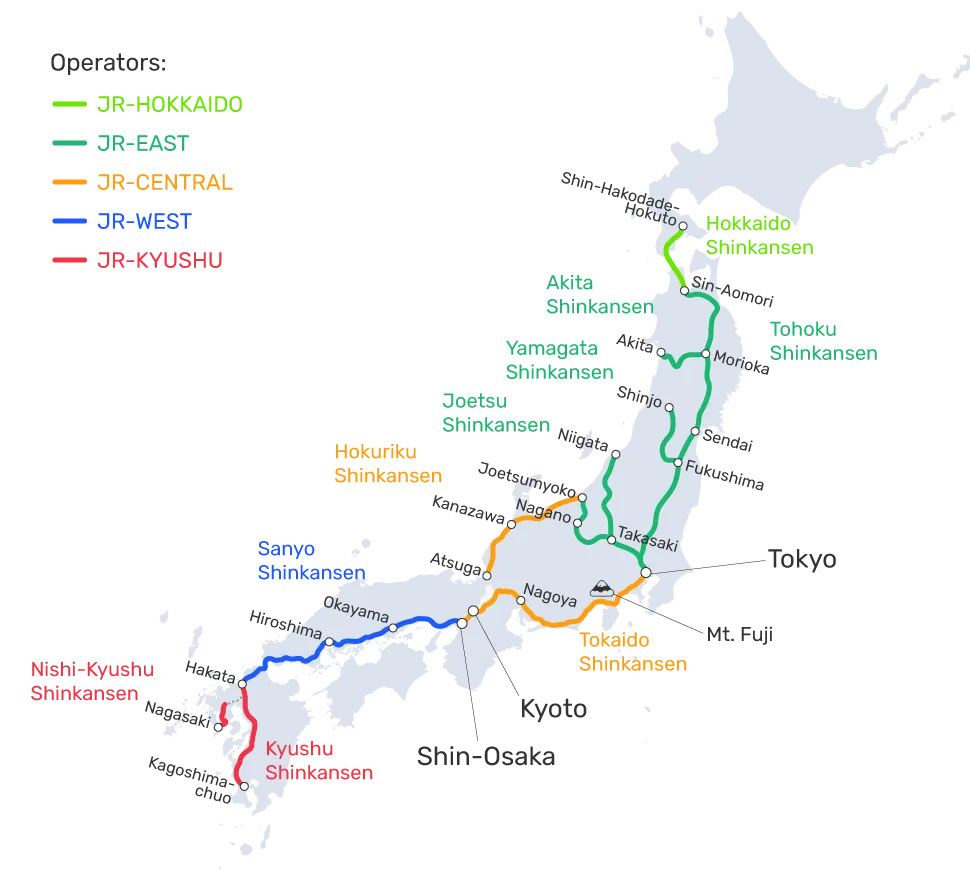
Once you get comfortable using local trains and buses in Japan, it is time to explore the country on a larger scale. For long-distance travel, the key option is Japan's world-famous high-speed railway, the Shinkansen (bullet train).
In this article, we'll cover the basics of riding the Shinkansen, how to buy tickets, important rules you should know, and the big question many travelers have: Do you really need the Japan Rail Pass?
Related article: #001 How to Use Public Transportation in Tokyo
1. What Is the Shinkansen?
The Shinkansen is a high-speed train network connecting major cities across Japan, with top speeds of up to 320 km/h (about 200 mph).
Key features of the Shinkansen are its exceptional punctuality and comfort. The average delay is less than one minute. Furthermore, unlike air travel, you don’t have to worry about complex security checks or long trips to the airport. With spacious seating, it is a convenient way to travel from city to city.
2. Seat Types and How to Choose
When buying a Shinkansen ticket, you will choose from three types of seats below.
Non-reserved seat (Jiyu-seki):
You can sit in any available seat in designated cars. This is the most affordable option, but during busy seasons (like major holidays), you may not find a seat and could end up standing.
Reserved seat (Shitei-seki):
It costs about 500 to 1,000 yen (around $3 to $6) more than a non-reserved seat, but your seat is guaranteed, so you can travel with peace of mind anytime.
Green Car (First Class):
This is equivalent to business or first class on an airplane. The seats are wider, the cars are quieter, and you can enjoy a more luxurious journey.
3. Important: Oversized Baggage Rule
On routes such as Tokyo to Nagoya, Kyoto, Osaka, and Fukuoka (Tokaido, Sanyo, and Kyushu Shinkansen), you must reserve space in advance if you bring large luggage. There is no additional fee for this reservation.
Please note that if you bring large luggage without a reservation, you will be required to pay a 1,000 yen fine, and your luggage may be moved to a different storage area.
What counts as oversized baggage?
Luggage with total dimensions (length + width + height) between 160 cm and 250 cm. (This usually means large suitcases that you would check in on an international flight).
What should you do?
When buying your ticket, select a seat with an oversized baggage area. There is no extra cost, but these seats are limited, so early booking is recommended.
🔗 More details:
Check → Oversized baggage | JAPAN RAIL PASS
4. How to Buy Tickets
Ticket Machines
Automatic ticket machines at stations support multiple languages, including English. They are convenient and easy to use at your own pace.
Ticket Office (Midori-no-Madoguchi)
Go to a staffed counter if you need assistance with a complex route. However, lines can be long, and not all staff are comfortable speaking English.
It helps to use a translation app or show a note such as:
“Tokyo → Kyoto / Nov 15 / 10:00 AM / 2 adults”
💡 Many Japanese people may not feel confident speaking English. However, they can often understand written English, especially simple words like place names and dates. Writing down your request on paper or your phone and showing it can make communication much smoother.
Online Reservation
You can book and pay with a credit card before arriving in Japan.
There are two official booking systems, depending on the region. (Japan Railways, or “JR”, is divided into regional companies, so the booking system changes based on your destination)
📱 Smart EX
For the southwest area
(Kyoto, Osaka, Hiroshima, Fukuoka, etc. / Tokaido, Sanyo, Kyushu Shinkansen)
For the northeast area
(Sendai, Aomori, Nagano, Kanazawa, etc. / Hokuriku, Joetsu, Yamagata, Akita, Tohoku, Hokkaido Shinkansen)
After purchasing online, you can ride using one of these methods:
- Link the ticket to an IC card (like Suica) and tap it at the gate
… For more on IC cards → #002 How to Get and Use an IC Card in Japan - Pick up a paper ticket at a station machine
… For JR-EAST, you may need the physical credit card used for the online purchase to verify your identity - Scan a QR code at the gate
… Currently only available via Smart EX as of April 2026
💡 What if your credit card doesn’t work on the official sites?
The official systems are reliable, but some foreign tourists may face payment errors with overseas credit cards, especially Visa and Mastercard.
If your card gets rejected, or if the Japanese website feels difficult to use, you can consider using Klook, a global travel booking platform.
It may charge a small service fee, but it offers benefits such as:
- Fewer payment errors (supports local currency, Apple Pay, Google Pay)
- A familiar and easy-to-use interface.
- Customer support is available in multiple languages.
🔍 Go to Klook → Shinkansen Tickets – Japan Bullet Train
5. Should You Buy the Japan Rail Pass?
The answer is simple: It depends on your itinerary.
Previously, the Japan Rail Pass was often considered an essential purchase for most tourists. However, after a major price increase in October 2023, this is no longer the case.
☑️ Who SHOULD NOT buy it:
Travelers just making a round trip between “Tokyo and Kyoto/Osaka.” In this case, buying individual tickets is usually cheaper.
☑️ Who SHOULD buy it:
Travelers planing to travel long distances across multiple regions within 7 or 14 days, such as Tokyo, Osaka, Hiroshima, and Kanazawa.
💡 Alternative Recommendation:
If the Japan Rail Pass feels like too much, but buying tickets one by one seems inefficient, “Regional Passes” can be a good middle option. For example, passes like the JR East Pass, the Hokuriku Arch Pass, or the JR TOKYO Wide Pass can offer good value depending on your itinerary.
- 🔗 Find Your Pass | JR-EAST
- 🔗 JR-WEST RAIL PASS | West Japan Railway Company
- 🔗 Other Rail Passes | West Japan Railway Company
6. Tips to Make the Most of Your Shinkansen Trip
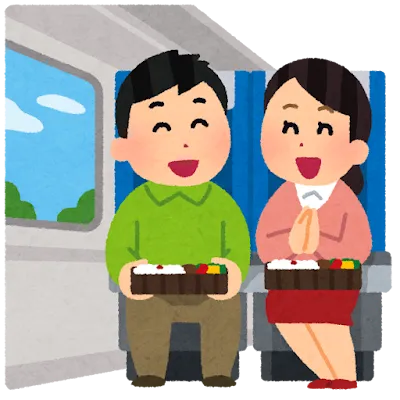
Try an “Ekiben”
“Eki” means station, and “ben” is short for bento. Ekiben refers to boxed lunches sold at stations.
Buying an ekiben and eating it on the train is a classic part of train travel in Japan. There are many varieties, and they often look as good as they taste.
Choosing a Seat to See Mt. Fuji
If you are traveling from Tokyo towards Kyoto or Osaka (heading west), book Seat E on the right side (or Seat D in Green Cars). If the weather is clear, you can enjoy a scenic view of Mt. Fuji right from your window.

The same seats apply even when traveling in the opposite direction, from western Japan to Tokyo. That is still the E/D side. And from Seat A, you can enjoy views of the ocean instead.
💡 You might be thinking, “If I am traveling east from Osaka to Tokyo, shouldn’t Seat A be on the correct side?”
Actually, in Japan, the train seats are physically rotated 180 degrees at terminal stations.
Because of this, the seat letter layout stays the same, and Seat E is always on the Mt. Fuji side.
If this article was useful to you, support via
 is appreciated.